
TABLE OF CONTENTS
・Bisection method
・Newton's method
Mathematics articles that help in reading this article
・Numerical Computation:Ep. 1, Ep. 2, Ep. 5, Ep. 6
・Numerical Computation:Ep. 1, Ep. 2, Ep. 5, Ep. 6

Kaya
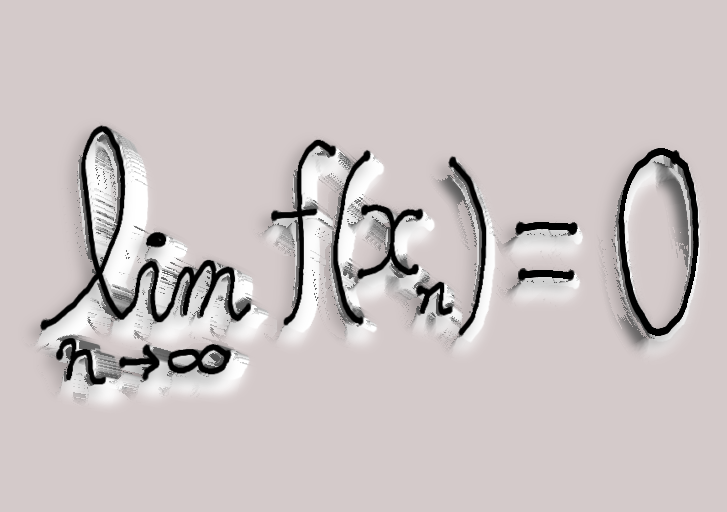
This time, let’s introduce two methods for finding numerical solutions of the equation \( f(x) = 0 \).
The first is the bisection method.
Bisection method

Nayumi
We’ve done the bisection method before, right?
Kaya
That’s right. Back then, we used the bisection method to find \( \sqrt{2} \). If we explain that more
generally as a method for solving the equation \( f(x) = 0 \), it goes like this.
\[ \text{Bisection method} \]
A numerical method for finding a solution of an equation \( f(x) = 0 \) .
This method consists of the following steps:
[1] Select an appropriate initial value of \( a_0 , b_0 \) that satisfies \[ f(a_0)f(b_0) \lt 0 , \ f(a_0) \gt 0 \] [2] If \( f \left( \frac{a_0 + b_0}{2} \right) \gt 0 \) , then \( a_1 = \frac{a_0 + b_0}{2} , \ b_1 = b_0 \) . If \( f \left( \frac{a_0 + b_0}{2} \right) \lt 0 \) , then \( a_1 = a_0 , \ b_1 = \frac{a_0 + b_0}{2} \) .
[3] Repeat the operation of finding \( a_{k+1} , b_{k+1} \) using \( a_k , b_k \ \ (k = 1, 2, 3, \ldots ) \) in the same way. Then, the following holds. \[ \lim _{k \to \infty} f \left( \frac{a_k + b_k }{2} \right) = 0 \]
[1] Select an appropriate initial value of \( a_0 , b_0 \) that satisfies \[ f(a_0)f(b_0) \lt 0 , \ f(a_0) \gt 0 \] [2] If \( f \left( \frac{a_0 + b_0}{2} \right) \gt 0 \) , then \( a_1 = \frac{a_0 + b_0}{2} , \ b_1 = b_0 \) . If \( f \left( \frac{a_0 + b_0}{2} \right) \lt 0 \) , then \( a_1 = a_0 , \ b_1 = \frac{a_0 + b_0}{2} \) .
[3] Repeat the operation of finding \( a_{k+1} , b_{k+1} \) using \( a_k , b_k \ \ (k = 1, 2, 3, \ldots ) \) in the same way. Then, the following holds. \[ \lim _{k \to \infty} f \left( \frac{a_k + b_k }{2} \right) = 0 \]
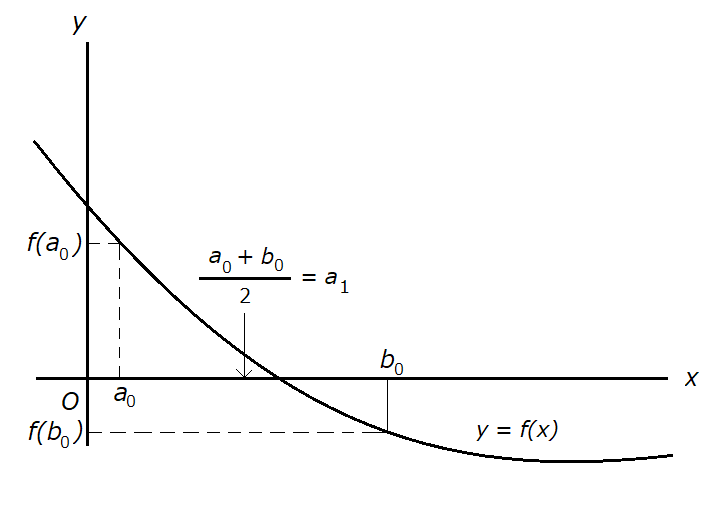
In the bisection method, we approach a solution of \( f(x) = 0 \) while bracketing it between \( a_k \) and
\( b_k \).
For \( k \geq 1 \),
\[ 0 \leq f \left( a_k \right) \leq f \left( a_{k-1} \right) \]
\[ 0 \geq f \left( b_k \right) \geq f \left( b_{k-1} \right) \]
hold.
Therefore, both \( a_k \) and \( b_k \) are guaranteed to get closer to the solution as \( k \) increases.
Nayumi
It’s a straightforward, no-nonsense method.
Kaya
Exactly. One of the strengths of the bisection method is that, regardless of the form of \( f(x) \), the
sequence always converges to a solution. Now then, let’s move on to Newton’s method.
Newton's method
Nayumi
Newton—that’s a name I’ve heard before.
Kaya
Newton was a scientist active in the 17th century. He was also one of the figures who contributed to the
development of calculus.

Isaac Newton(1642-1727)
Nayumi
So he was one of the people who created differentiation and integration. Then what kind of method is
Newton’s method?
Kaya
It works like this.
\[ \text{Newton's method of approximation} \]
A method for approximately finding \( x \) such that \( f(x) = 0 \) for a differentiable function of
one variable \( f(x) \) over the real numbers.
The method consists of the following steps:
[1] Choose an appropriate initial value \( x_0 \) such that \( f(x_0) \neq 0 \).
[2] Compute \( x_k \) iteratively using the following formula: \[ x_{k} = x_{k-1} - \frac{f \left( x_{k-1} \right) }{f' \left( x_{k-1} \right) } \] for \( k = 1,2,3, \dots \).
[3] Depending on the choice of the initial value, the sequence may satisfy: \[ \lim _{k \to \infty} f \left( x_k \right) = 0. \] However, in some cases, this condition may not hold.
[1] Choose an appropriate initial value \( x_0 \) such that \( f(x_0) \neq 0 \).
[2] Compute \( x_k \) iteratively using the following formula: \[ x_{k} = x_{k-1} - \frac{f \left( x_{k-1} \right) }{f' \left( x_{k-1} \right) } \] for \( k = 1,2,3, \dots \).
[3] Depending on the choice of the initial value, the sequence may satisfy: \[ \lim _{k \to \infty} f \left( x_k \right) = 0. \] However, in some cases, this condition may not hold.
Kaya
And it turns out like this.
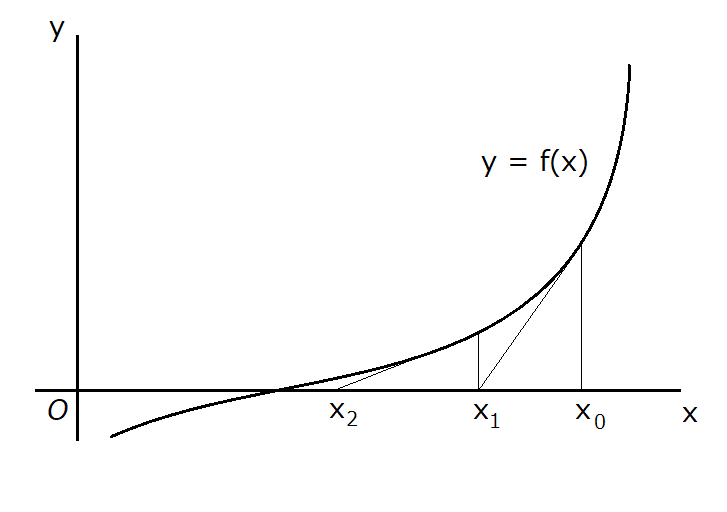
Unlike the bisection method, Newton’s method can only be used when \( f(x) \) is differentiable and its
derivative \( f'(x) \) is known.
The iterative process starts from \( x_0 \) and repeatedly takes \( x_1 \) to be the point where the tangent
line to the curve at \( \left( x_0 , f \left( x_0 \right) \right) \) intersects the \( x \)-axis , and
continues this loop.
Also, unlike the bisection method, Newton’s method does not always produce a convergent sequence.
For example, for
\[ f(x) = x^3 -2x + 2,\]
if we apply Newton’s method with the initial value \( x_0 = 0 \), we obtain \( x_2 = x_0 \) as shown below,
and the process falls into an infinite loop.
\[ f' (x) = 3 x^2 -2 \]
Therefore,
\[ \begin{align}
x_{1} &= x_0 - \frac{f \left( x_0 \right) }{ f' \left( x_0 \right) } \\\\
&= 0 - \frac{0^3 -2 \cdot 0 + 2}{3 \cdot 0^2 -2} \\\\
&= 0 - (-1) = 1 \\\\
x_{2} &= x_1 - \frac{f \left( x_1 \right) }{ f' \left( x_1 \right) } \\\\
&= 1 - \frac{1^3 -2 \cdot 1 + 2}{3 \cdot 1^2 - 2} \\\\
&= 1 - \frac{1}{1} = 0
\end{align}\]
Although Newton’s method has various drawbacks, it has the advantage that, when the conditions are right,
the sequence converges faster than in the bisection method.
In practice, when seeking an approximate solution \( x \) to \( f(x) = 0 \), the standard approach is to try
Newton’s method first and, if it does not work well, to switch to the bisection method.
Nayumi
So you try Newton’s method first, and if it seems difficult, you switch to the more stable bisection
method.
Kaya
That sounds like a good approach.
References:
[1] Wikipedia Isaac Newton, https://en.wikipedia.org/wiki/Isaac_Newton,
February 3, 2026
[2] Wikipedia Newton's method, https://en.wikipedia.org/wiki/Newton%27s_method
, February 3, 2026
[3] Wikipedia Bisection method, https://en.wikipedia.org/wiki/Bisection_method,
February 3, 2026
Previous
Ep. 11
Partial fraction decomposition
Partial fraction decomposition
Next
Ep. 13
Definite integral
Definite integral