
TABLE OF CONTENTS
・Function of one variable
・Limit of a function
・Continuity of functions
・Note: composite functions and inverse functions

Kaya
This time, let's talk about the function of one variable.
Function of one variable

Nayumi
Is the function of one variable a function?
Kaya
Well, when we simply say 'function,' it usually refers to a function of one variable. However, since
there are also multivariable functions that have two or more variables, we explicitly call it a function
of one variable here.
A relationship \( f \) in which the value of variable \( y \) is uniquely determined by the value of a
single variable \( x \) is called a function of one variable, and it is expressed as \( y = f(x) \).
In this context, \( x \) is called the independent variable, and \( y \) is called the dependent
variable.
The range of values that \( x \) can take is called the domain, and the range of values that \( y \)
can take is called the image.
Unless otherwise specified, the domain is often assumed to be all real numbers.
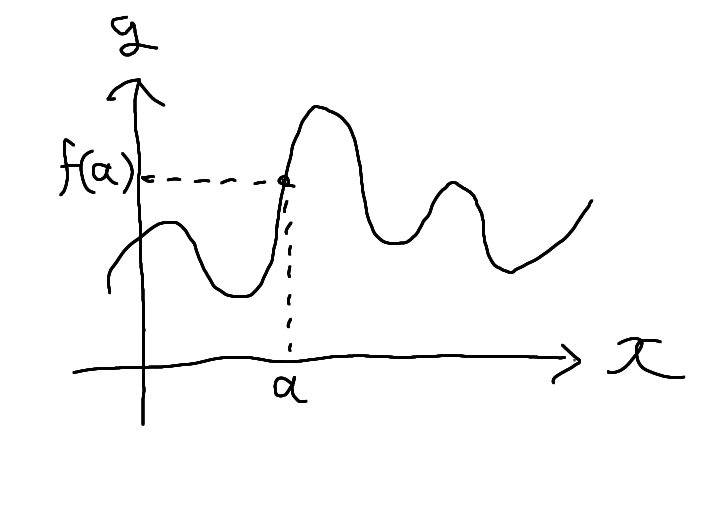
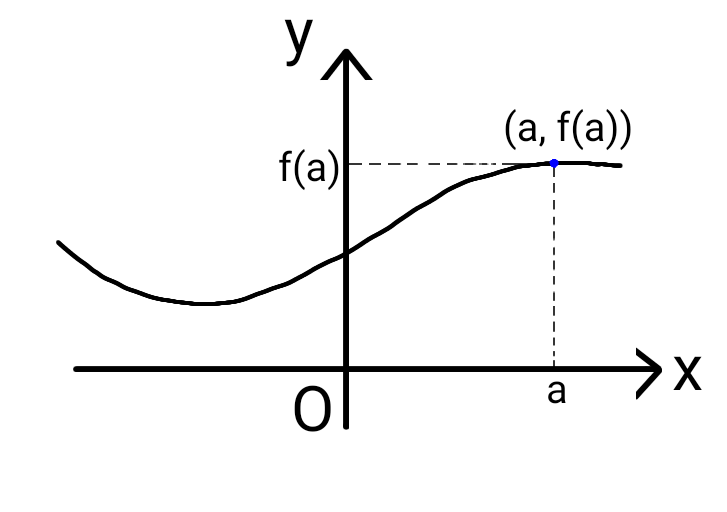
For the function \( y = f(x) \), the set of all points \( (x, y) \) that satisfy this relationship is called the graph of the function \( y = f(x) \). When illustrated, the graph appears as shown below, where the value \( a \) on the \( x \)-axis corresponds to the value \( f(a) \) on the \( y \)-axis. The symbol \( O \) written at the intersection of the \( x \)-axis and the \( y \)-axis represents the origin, which corresponds to the point \( (x, y) = (0, 0) \).
For the function \( y = f(x) \), the set of all points \( (x, y) \) that satisfy this relationship is called the graph of the function \( y = f(x) \). When illustrated, the graph appears as shown below, where the value \( a \) on the \( x \)-axis corresponds to the value \( f(a) \) on the \( y \)-axis. The symbol \( O \) written at the intersection of the \( x \)-axis and the \( y \)-axis represents the origin, which corresponds to the point \( (x, y) = (0, 0) \).
Nayumi
Hmm, I see. So now I understand about functions of one variable and their graphs.
Kaya
Alright, then let’s move on and talk about the limits of functions next.
Limit of a function
For a function \( y = f(x) \), if the value of \( y \) approaches \( b \) infinitely closely as \( x \)
approaches \( a \) without actually reaching \( a \), then we say that \( y = f(x) \) converges
to \( b \) as \( x \to a \). In this case, \( b \) is called the limit, and it is expressed as:
\[ \lim _{x \to a} f(x) = b \]
The phrase “as \( x \) approaches \( a \) without actually reaching \( a \)” in the definition of a limit
cleverly avoids the subtle issues related to zero.
For example, let's consider the process of finding instantaneous speed. We obtain the instantaneous speed by making the time interval \( \Delta t \) for average speed infinitely small. But what happens if we set this time interval \( \Delta t = 0 \)? If the time interval is \( 0 \), it means no time has passed, so the change should be stopped. In this case, the instantaneous speed would be \( 0 \). However, with this reasoning, since no time is passing at any moment, the instantaneous speed would always be \( 0 \), and no change would occur.
This idea is a generalization of the paradox "The arrow in flight does not move," which is attributed to the ancient Greek philosopher Zeno. Zeno argued that at every instant of the flying arrow, if you isolate that moment, the arrow is stationary, and thus, he claimed that the flying arrow is always at rest. It is a bit of a sophistry, but when we start considering the time interval \( \Delta t = 0 \), we inevitably face such paradoxical reasoning. To avoid confronting this problem, the definition of a limit, as we saw earlier, is used.
The key point of the definition of the limit is that the expression "approaching \( a \)" focuses not on how close you get to a certain number, but on the process of getting closer and closer to that number.
For example, let's consider the process of finding instantaneous speed. We obtain the instantaneous speed by making the time interval \( \Delta t \) for average speed infinitely small. But what happens if we set this time interval \( \Delta t = 0 \)? If the time interval is \( 0 \), it means no time has passed, so the change should be stopped. In this case, the instantaneous speed would be \( 0 \). However, with this reasoning, since no time is passing at any moment, the instantaneous speed would always be \( 0 \), and no change would occur.
This idea is a generalization of the paradox "The arrow in flight does not move," which is attributed to the ancient Greek philosopher Zeno. Zeno argued that at every instant of the flying arrow, if you isolate that moment, the arrow is stationary, and thus, he claimed that the flying arrow is always at rest. It is a bit of a sophistry, but when we start considering the time interval \( \Delta t = 0 \), we inevitably face such paradoxical reasoning. To avoid confronting this problem, the definition of a limit, as we saw earlier, is used.
The key point of the definition of the limit is that the expression "approaching \( a \)" focuses not on how close you get to a certain number, but on the process of getting closer and closer to that number.

Nayumi
Limits can be quite a troublesome problem once you start thinking about them...
Kaya
Alright, then. Let's finish up by talking about the continuity of functions.
Continuity of functions
Nayumi
What is continuous in continuity?
Kaya
It means that the graph is continuous.
The function \( y = f(x) \) is continuous at \( a \) if
\[ \lim_{x \to a} f(x) = f(a) \ .\]
In most numerical experiments, the functions we deal with are continuous over all real numbers, so we
usually don’t need to worry much about the continuity of the function.
However, the continuity of functions is an important concept to remember, as it plays a key role in the
proofs of various theorems that will appear later.
To give an example of a function that is not continuous, there is the floor function.
To give an example of a function that is not continuous, there is the floor function.
\[ y = \lfloor x \rfloor \ \ ( \lfloor x \rfloor \ \text{represents the largest integer less than or
equal to} \ x ) \]
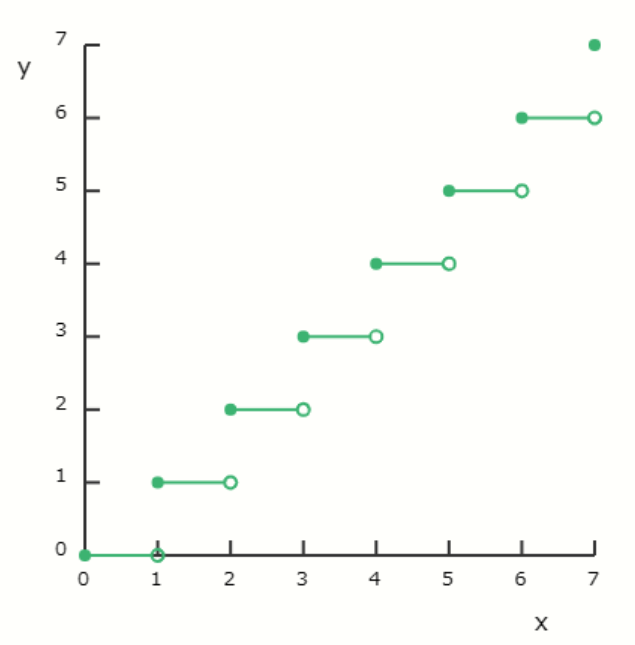
The graph of the floor function is discontinuous at \( x = n \) (where \( n \) is an integer).
The gaps on the right side occur because the floor function "cuts off" the decimal part.
If \( x \) is slightly greater than an integer, the floor function gives the value of that integer. However, if \( x \) is slightly smaller than an integer, the floor function gives the integer just below it. To visualize it, think of the floor function as the floor of a building at the height of an integer, where the objects inside the building are classified according to the floor they are directly beneath.
If \( x \) is slightly greater than an integer, the floor function gives the value of that integer. However, if \( x \) is slightly smaller than an integer, the floor function gives the integer just below it. To visualize it, think of the floor function as the floor of a building at the height of an integer, where the objects inside the building are classified according to the floor they are directly beneath.
Nayumi
The floor function is like a teacher who is strict about time.
Kaya
"Latecomers beware," huh?
Nayumi
It would be nice if it were a little more lenient.
Note: composite functions and inverse functions
If there are two functions \( u = f(x) \) and \( y = g(u) \), and the image of \( u = f(x) \) is included
in the domain of \( y = g(u) \), then the function \( y = g(f(x)) \) can be defined, which is called the
composite function of \( f \) and \( g \).
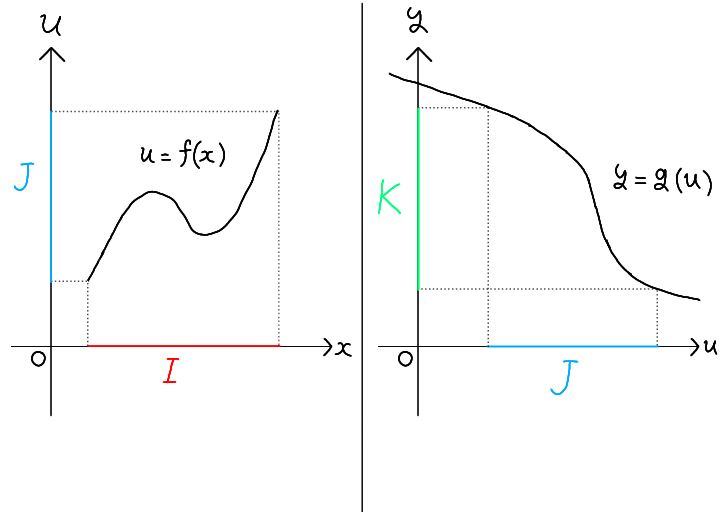
The domain of the composite function \( y = g(f(x)) \) is the same as the domain of \( u = f(x) \) (denoted \( I \) in the figure). Its range is equal to the range of \( y = g(u) \) when the domain of \( g \) is taken to be the range of \( u = f(x) \) (denoted \( J \) in the figure). The resulting range is denoted \( K \).
The domain of the composite function \( y = g(f(x)) \) is the same as the domain of \( u = f(x) \) (denoted \( I \) in the figure). Its range is equal to the range of \( y = g(u) \) when the domain of \( g \) is taken to be the range of \( u = f(x) \) (denoted \( J \) in the figure). The resulting range is denoted \( K \).
Nayumi
By combining \( I \to J \) and \( J \to K \), we’ve essentially turned it into \( I \to K \), right?
Kaya
Exactly. Now, let’s move on to inverse functions.
For a function \( y = f(x) \), if \( f(a) \leq f(b) \) holds for all \( a \leq b \) in its domain, we say
that \( f(x) \) is a monotonically increasing function.
Conversely, if \( f(a) \geq f(b) \) holds for all \( a \leq b \) in its domain, we say that \( f(x) \) is a
monotonically decreasing function.
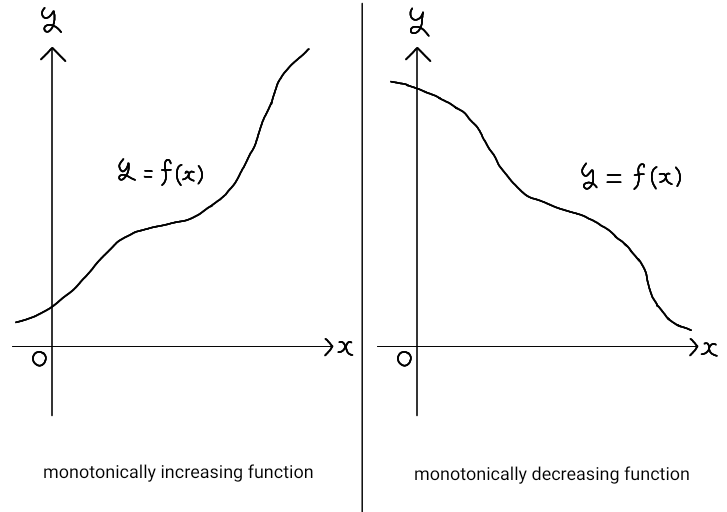
Let \( y = f(x) \) be a continuous and monotonic (increasing or decreasing) function on its domain.
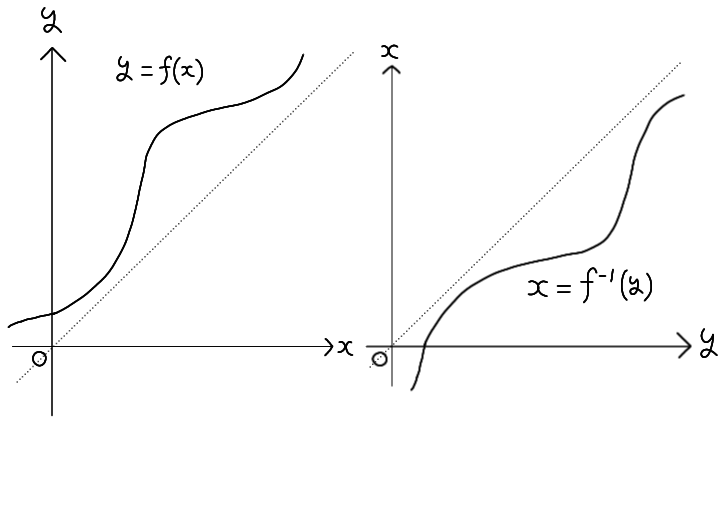
In this case, the function that assigns \( x \) to each \( y \) is called the inverse function of \(
y = f(x) \), and is denoted by \( x = f^{-1}(y) \).
Alternatively, by interchanging \( x \) and \( y \), it can be written as \( y = f^{-1}(x) \).
The graph of \( y = f(x) \) becomes the graph of \( x = f^{-1}(y) \) when reflected across the line \( y = x \).
The graph of \( y = f(x) \) becomes the graph of \( x = f^{-1}(y) \) when reflected across the line \( y = x \).
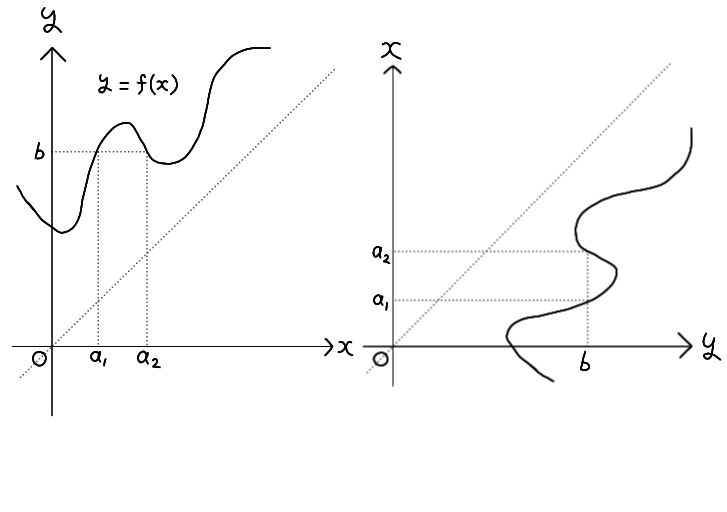
Also note that if \( y = f(x) \) is not monotonic (increasing or decreasing) on its domain, then for some
values of \( y \), the corresponding value of \( x \) is not uniquely determined, and therefore an inverse
function cannot be defined.
Nayumi
Whether you look from \( x \) to \( y \) or from \( y \) to \( x \), you can define an inverse function only when each side corresponds to exactly one value, right?
Kaya
Exactly.
References:
[1] Wikipedia Zeno's paradoxes, https://en.wikipedia.org/wiki/Zeno%27s_paradoxes、July
15, 2023
[2] 森毅, 位相のこころ, 筑摩書房, January 10, 2006
[3] 石村園子, やさしく学べる微分積分, 共立出版, December 25, 1999
[4] 難波 誠, 数学シリーズ 微分積分学, 裳華房, January 20, 2009
Previous
Ep. 1
Numbers
Numbers
Next
Ep. 3
Straight line and
conic section
Straight line and
conic section