
TABLE OF CONTENTS
・Numbers

Kaya
In the 'Numerical Computation' section, I plan to discuss the mathematics necessary to understand
numerical experiments.

Nayumi
Math can be difficult, so keeping up is quite challenging.
Kaya
That's true. Math isn't something you can grasp easily. But if you take it step by step, you'll be able
to understand it.

Nayumi
Well, if you put it that way, I'll give it my best shot.
Numbers
Kaya
Let's start by learning about numbers.
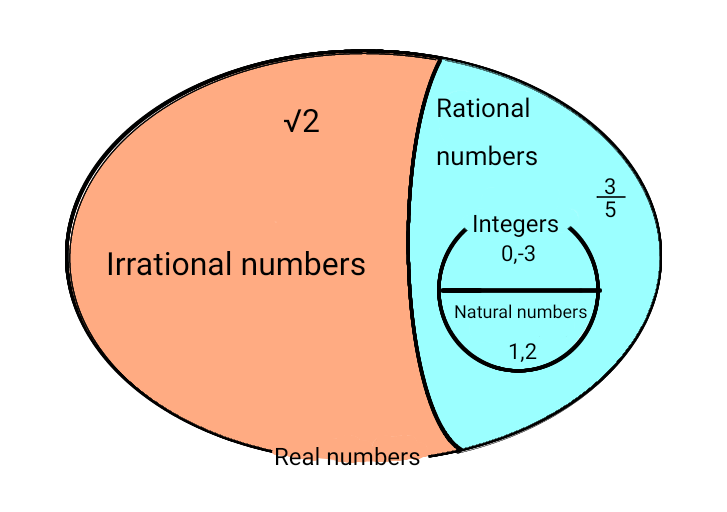
The most familiar numbers in everyday life are natural numbers. Natural numbers are
\[ 1, 2, 3, \ldots \]
These are the numbers we use for counting objects. When we add zero (\(0\)) and negative (\(-\)) versions of
natural numbers, we get integers.
For example, \(3\) is both a natural number and an integer. On the other hand, \(-3\) is an integer but not
a natural number.
In elementary school, you probably learned subtraction as taking away a natural number, like \(3\). But by
treating \(-3\) as a single number, we can also define operations like \(2 - 5\), where a smaller number is
subtracted from a larger one, allowing us to find meaningful results for such calculations.
Nayumi
We've talked about natural numbers and integers, but are there other kinds of numbers as well?
Kaya
As another familiar type of number in everyday life, there are rational numbers.
Rational numbers consist of terminating decimals and repeating decimals.
A terminating decimal is what we commonly think of as a decimal number, such as \(0.5\) or \(0.25\).
A repeating decimal, as the name suggests, is a decimal that continues infinitely with a repeating pattern.
For example, \(0.272727\ldots\) has the digits \(2\) and \(7\) repeating endlessly.
We can also represent repeating decimals by placing a horizontal line (a vinculum) above the repeating
digits, like this:
\[ 0.272727\ldots = 0.\overline{27} \]
Any rational number can be expressed as a ratio of two integers—that is, a fraction where both the numerator and denominator are integers. For terminating decimals, we can express them as fractions by shifting the decimal point to the right until the number becomes an integer and then dividing by the corresponding power of \(10\). For example: \[ \begin{align} 0.1543 &= \frac{1543}{10 \times 10 \times 10 \times 10} \\\\ &= \frac{1543}{10000} \end{align} \] For repeating decimals, the process requires a bit more work. Let’s use \(0.123123123\ldots = 0.\dot{1}2\dot{3}\) as a concrete example to demonstrate how to convert it into a fraction.
Any rational number can be expressed as a ratio of two integers—that is, a fraction where both the numerator and denominator are integers. For terminating decimals, we can express them as fractions by shifting the decimal point to the right until the number becomes an integer and then dividing by the corresponding power of \(10\). For example: \[ \begin{align} 0.1543 &= \frac{1543}{10 \times 10 \times 10 \times 10} \\\\ &= \frac{1543}{10000} \end{align} \] For repeating decimals, the process requires a bit more work. Let’s use \(0.123123123\ldots = 0.\dot{1}2\dot{3}\) as a concrete example to demonstrate how to convert it into a fraction.
\[ \begin{align}
x &= 0.123123123 \ldots \\\\
1000x &= 123.123123 \ldots \\\\
1000x - x &= 123.123123 \ldots - 0.123123123 \ldots \\\\
999x &= 123 \\\\
x &= \frac{123}{999} = 0.123123123 \ldots
\end{align}\]
This method hinges on the calculation in the third line, where by multiplying the original repeating decimal
by \(1000\) and then subtracting the original repeating decimal, we cancel out the decimal part.
Then, in the fourth line, the remaining \(123\) on the right-hand side and the left-hand side, which is the
original repeating decimal multiplied by \(999\) (since \(1000 - 1 = 999\)), allows us to solve for \(x\).
This gives us the fraction of the original repeating decimal, which is \( \frac{123}{999} \).
Nayumi
There are various ways to represent rational numbers. Does this cover all types of numbers?
Kaya
There are also irrational numbers.
Irrational numbers are infinite decimals that do not repeat. Unlike rational numbers, irrational
numbers cannot be expressed as a ratio of two integers. A familiar example of an irrational number is the
length of the diagonal of a square with side length 1, which is \( \sqrt{2} \). This is an irrational
number. The symbol \( \sqrt{} \) is called the radical sign and is read as 'square root of ...' This
number, \( \sqrt{2} \), is the value that, when multiplied by itself, gives 2, and it continues infinitely
without repeating:
\[
\sqrt{2} = 1.41421356\ldots
\]
Another number that satisfies the condition of multiplying by itself to give 2 is \( -\sqrt{2} \), which is
\[ \begin{align}
\left( - \sqrt{2} \right) \times \left( - \sqrt{2} \right) &= \left( (-1) \times \sqrt{2} \right) \times
\left( (-1) \times \sqrt{2} \right) \\\\
&= (-1) \times (-1) \times \sqrt{2} \times \sqrt{2} \\\\
&= 1 \times 2 \\\\
&= 2
\end{align}\]
With that in mind, we can think of it this way. In expressions that only involve multiplication, the order
of multiplication can be swapped. Also, remember that multiplying by \( -1 \) reverses the plus-minus sign.
Nayumi
How can we specifically find an irrational number like \( \sqrt{2} \) ?
Kaya
There are various methods to find such numbers, but the most basic approach is probably this one.
(1) \( 1 \times 1 = 1 \lt 2 \), and \( 2 \times 2 = 4 \gt 2 \), so we can infer that the number which,
when multiplied by itself, gives 2, i.e., \( \sqrt{2} \), is greater than 1 and less than 2.
(2) The average of 1 and 2 is \( (1 + 2) \div 2 = 1.5 \). Here, \( 1.5 \times 1.5 = 2.25 \gt 2 \). Therefore, we can conclude that \( \sqrt{2} \) is greater than 1 and less than 1.5.
(3) The average of 1 and 1.5 is \( (1 + 1.5) \div 2 = 1.25 \). Here, \( 1.25 \times 1.25 = 1.5625 \lt 2 \). Therefore, we can conclude that \( \sqrt{2} \) is greater than 1.25 and less than 1.5.
(4) From here on, we continue in the same manner by taking the average of two numbers. If squaring the average results in a value smaller than 2, we replace it with the smaller of the two previous numbers. If it is greater than 2, we replace it with the larger of the two previous numbers. This process is repeated.
(2) The average of 1 and 2 is \( (1 + 2) \div 2 = 1.5 \). Here, \( 1.5 \times 1.5 = 2.25 \gt 2 \). Therefore, we can conclude that \( \sqrt{2} \) is greater than 1 and less than 1.5.
(3) The average of 1 and 1.5 is \( (1 + 1.5) \div 2 = 1.25 \). Here, \( 1.25 \times 1.25 = 1.5625 \lt 2 \). Therefore, we can conclude that \( \sqrt{2} \) is greater than 1.25 and less than 1.5.
(4) From here on, we continue in the same manner by taking the average of two numbers. If squaring the average results in a value smaller than 2, we replace it with the smaller of the two previous numbers. If it is greater than 2, we replace it with the larger of the two previous numbers. This process is repeated.
Nayumi
I see... It definitely has a kind of rough yet effective approach to it.
Kaya
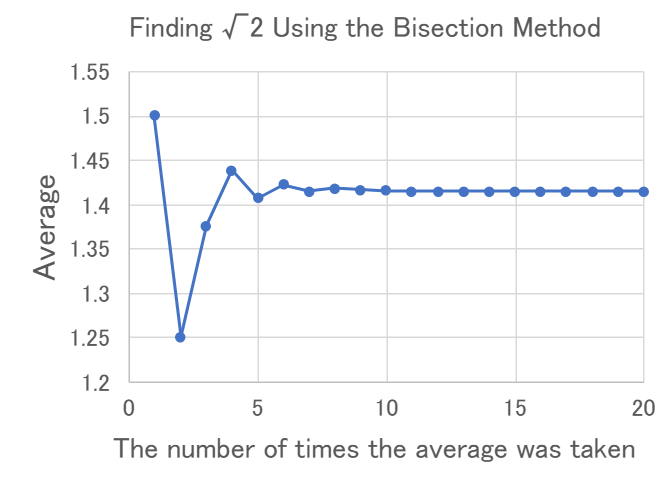
I'll probably explain this in more detail later, but this method is called the bisection method.
Here are the results after performing the averaging process 20 times.
Nayumi
Oh, it really settles around 1.4.
The numbers we have explained so far are the main ones that appear in numerical experiments. Natural
numbers, integers, rational numbers, and irrational numbers are collectively called real numbers.
References:
[1] Wikipedia Rational number, https://en.wikipedia.org/wiki/Rational_number,
July 13, 2023
[2] James R. Newman, THE UNIVERSAL ENCYCLOPEDIA OF MATHEMATICS, George Allen & Unwin Ltd, 1964
Next
Ep. 2
Function of
one variable
Function of
one variable