
TABLE OF CONTENTS
・How to build a mathematical model
・How to build a mathematical model: practical edition

Nayumi
Scientists really come up with all kinds of models, don’t they? I wonder how they think of those things.

Kaya
Well, some might be based on flashes of genius or lucky discoveries, but I think a lot of it comes from
steady, persistent effort.

Nayumi
Persistent effort, huh... Do you think if I work hard enough, I could do something like that too?
Kaya
Hmm, maybe. Well then, how about we learn a bit about how to build a mathematical model?
Nayumi
Yeah, let’s do it!
How to build a mathematical model
Kaya
Let's get right to it — the process of building a mathematical model generally goes something like this.
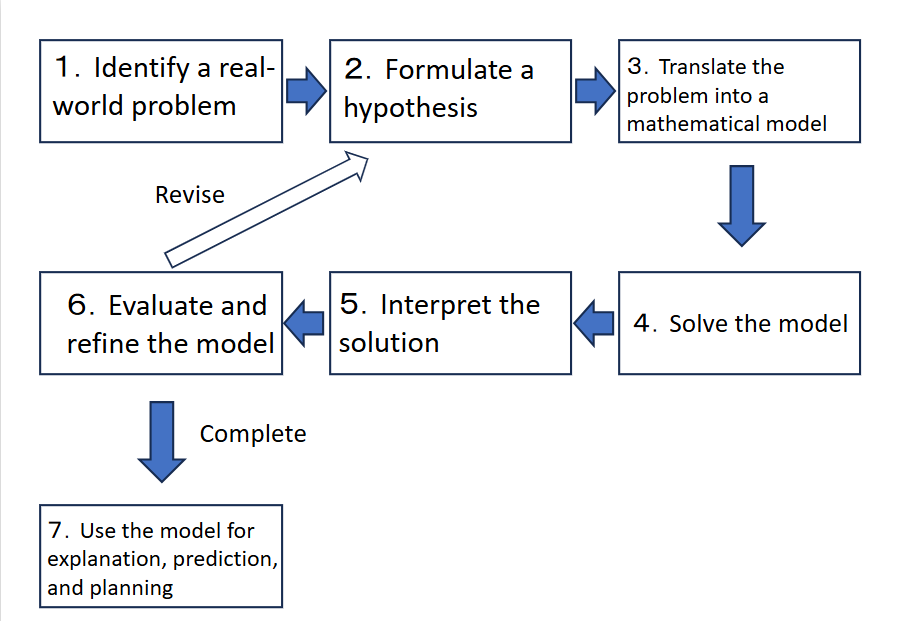
The process of constructing a mathematical model is broken down into seven steps.
The first step is to extract a problem from reality.
At this stage, it is important to describe the problem as concretely and clearly as possible in words—this
makes it easier to proceed to the next step.
The second step is to formulate a hypothesis.
There are many ways to do this, but a good starting point is to ask:
・What factors are related to what I want to investigate?
・How are those factors related?
Focusing on these questions can help build a solid hypothesis.
The third step is to construct a mathematical model that represents the hypothesis.
This step involves expressing the hypothesis in mathematical terms, often by referring to existing models
and methods.
In many cases, the mathematical tools needed already exist, but in some cases, it may be necessary to
develop new ones.
The fourth step is to solve the mathematical model.
Methods for doing this may include analytical techniques, numerical integration, or more complex algorithms,
depending on the situation.
The fifth step is to interpret the solution.
You need to investigate things like:
— How are the variables related?
— When one variable increases, does another increase or decrease?
— How does the solution change depending on parameter values?
Ultimately, you must consider what these mathematical results mean in the context of the real-world
problem.
The sixth step is to evaluate and refine the model.
You check whether the model appropriately reflects reality.
If there are significant discrepancies between the model and actual observations, you may need to revise
parts of the model—or even return to the hypothesis stage and start over.
The seventh and final step is to apply the model—to explain real-world phenomena, make predictions
about the future, or design strategies based on the model’s outcomes.
This is the ultimate purpose of constructing a mathematical model.
These seven steps outline the general process of building a mathematical model.
However, it’s not necessary to follow them in strict order.
Once you become familiar with the process, you can move flexibly between steps as needed.
Kaya
Just a side note, but school math mostly focuses on Step 4—the solving part.
Nayumi
Now that you mention it, we were definitely taught a lot about solving equations, but I don’t remember
hearing much about how math can be used to describe real-world problems.

Kaya
Exactly. In entrance exams, they have to make math into tough puzzles, otherwise it’s hard to
differentiate students by score. So school math naturally leans toward teaching how to solve those
puzzles. I get that. But personally, I think it wouldn’t hurt to show more of the connection between
math and real-life problems.
Nayumi
I agree. It’d be nice if we had more chances to learn about real-world applications of math—even outside
of science class.

Kaya
That’s how I feel too. So then, let’s try applying everything we’ve talked about to a really simple
example.
How to build a mathematical model: practical edition
Nayumi
A practical example... I wonder what exactly we're going to investigate?
Kaya
This time, let's try predicting when humans might be able to run 100 meters in under 9 seconds. We'll
start by adopting the following hypothesis.
\[ \text{The men's 100-meter WR has been decreasing in proportion to time.}\]
Although this is a very simple hypothesis, viewing a phenomenon as changing in proportion to time is a
crucial first step in modeling.
Based on this hypothesis, we arrive at the following mathematical model:
\[ R(t) = at + b \]
Here, \( R \) represents the record (in seconds), \( t \) is time (in years), and \( a \) and \( b \) are
constants.
In this model, the record is treated as a function of time, following a proportional (linear)
relationship—essentially, it's the equation of a straight line.
Since we've kept the model this simple, this equation itself can be considered the solution to the model.
Nayumi
Well, that didn’t take much effort to solve.
Kaya
Maybe it wasn’t very challenging, but that’s just because we chose a simple example—so forgive me. What
this model tells us, quite obviously, is that the record \( R \) changes in proportion to time \( t \).
Nayumi
Right. Since the record is expected to keep improving (i.e., decreasing), the constant \( a \) would
probably be negative.
Kaya
Yeah, that’s likely. Anyway, now that we have a general idea of how the model behaves, I checked how
well it actually fits the historical world records—and here’s what I found.
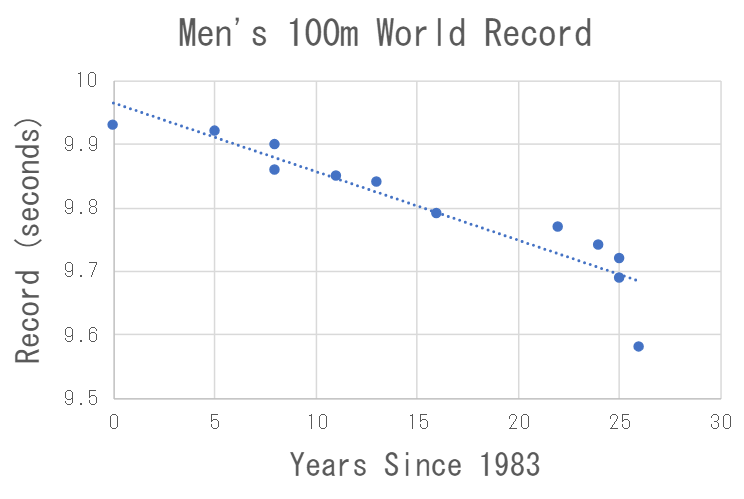
The records indicated by blue dots in the graph are taken from the Wikipedia page "Men's 100 metres world
record progression."
The dashed line in the graph represents the model. With the parameter values included, the model is
expressed by the following equation.
\[ R(t) = -0.0108t + 9.9633 \]
From the value of \( a \), we can see that the world record has been improving at a pace of approximately
0.0108 seconds per year.
The final data point doesn't fall on the straight line, however. This point represents the 9.58-second world
record set by Usain Bolt at the 2009 World Championships in Berlin.
Just one year earlier, at the 2008 Beijing Olympics, Bolt had already set a world record of 9.69 seconds.
In other words, the record improved by 0.11 seconds in a single year—ten times faster than the average pace
of improvement.
Kaya
Bolt really was incredible, huh?
Nayumi
Yeah, definitely. By the way, I noticed this graph starts from 1983—are there no records from before
that?
Kaya
Oh, there are records from before 1983, but some of them were measured manually. So for this analysis, I
only used data from after the switch to electronic timing.
Nayumi
They used to measure by hand?
Kaya
Apparently it took three people to do the timing.
Nayumi
Wow… that really shows how much times have changed.
Kaya
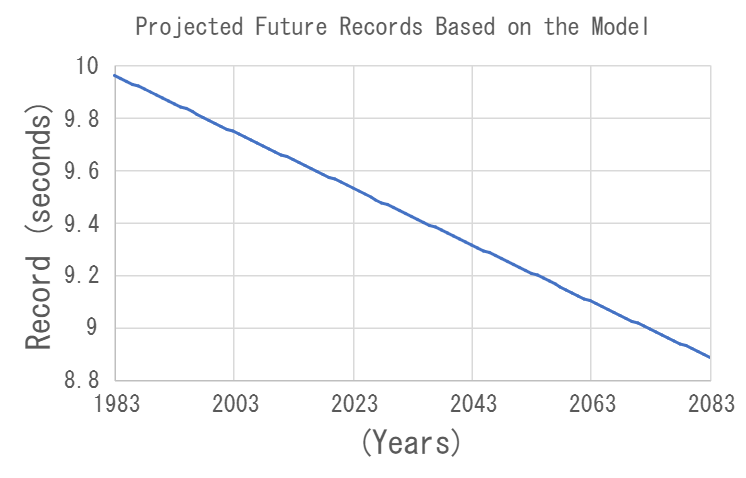
Yeah, it does. Anyway, here's a graph predicting how the record might improve up to the year 2083—100
years after 1983—based on our model.
Nayumi
Looks like it breaks into the 9-second range.

Kaya
Yeah. According to this graph, we can expect the record to drop below 9 seconds by 2073. That’s about 50
years from now—Kaya might still be around then.
Nayumi
It’d be great to see it happen while we’re still alive.
Kaya
Definitely. Gotta stay healthy and keep at it.

Nayumi
I’m glad I got to learn how to build mathematical models today. Thanks!
Kaya
You’re welcome! Making your own models and exploring different real-world examples really helps deepen
understanding, so be sure to check out other articles like
“Numerical Experiments.”
References:
[1] David Burghes/Morag Borrie, Modelling with Differential Equations, Ellis Horwood Ltd, April 22, 1981
[2] Wikipedia Men's 100 metres world record progression,https://en.wikipedia.org/wiki/Men%27s_100_metres_world_record_progression,
August 4, 2023
