
TABLE OF CONTENTS
・Set
・Union/Intersection
・Index set
・Complement
・Power set
・Cartesian product
・Cardinality

Kaya
This time, let’s talk about sets.
Set
\[ \text{Set}\]
A well-defined "collection of objects" is called a set.

Nayumi
Uh… well, I guess so.
Kaya
Yeah, that’s how it is. Next, we’ll define whether an individual “object” belongs to a given set or not
using the following notation.
\[ \text{Element}\]
Each individual object that forms a set is called an element or member of the set.
When \( x \) is an element of set \( X \), it is written as:
\[ x \in X \quad \text{or} \quad X \ni x \]
This can also be expressed as "\( x \) belongs to \( X \)", "\( x \) is contained in \( X
\)", or "\( X \) contains \( x \)".
On the other hand, when \( x \) is not an element of \( X \), it is written as:
\[ x \notin X \quad \text{or} \quad X \not\ni x\]

Nayumi
Hmm, so it’s like the element “ramen” being in the set “noodles”?
Kaya
Yeah, that’s the idea. Next, let’s look at two ways of representing sets.
\[ \text{Notation for Sets}\]
When all elements of a set can be listed as \( a, b, c, \ldots \), the set is represented by the
notation
\[ \{ a, b, c, \ldots \}.\]
This is called the extensional notation of a set.
On the other hand, when a certain condition \( C(x) \) is given, the set of all \( x \) that satisfy
this condition is represented by the notation
\[ \{ x \mid C(x) \}.\]
This notation is called the intensional notation of a set.
Nayumi
So it’s either writing out every element one by one, or just writing the rule that classifies them.
Kaya
Exactly. Next, let’s talk about classifying sets by the number of elements they contain.
\[ \text{Classification of Sets by the Number of Elements}\]
A set with a finite number of elements is called a finite set, while a set with infinitely many
elements is called an infinite set.
A set that contains no elements is called the empty set, represented by the symbol \[ \varnothing.\]
A set that contains no elements is called the empty set, represented by the symbol \[ \varnothing.\]
Infinite sets may seem not to exist when we think about things in the real world, but there are many of
them in the world of mathematics.
For example, the set of all natural numbers is an infinite set, and the real interval \( \left[0,1 \right]
\) is also an infinite set.
Nayumi
Right. Natural numbers can keep getting larger without bound, and within a real interval you can divide
it as finely as you like and still get real numbers.
Kaya
Exactly. Next, let’s define some terms that describe the relationships between two sets.
\[ \text{Subset}\]
Let \( X \) and \( Y \) be two sets. If every element of \( X \) is an element of \( Y \), and every
element of \( Y \) is an element of \( X \), then \( X \) and \( Y \) are said to be equal,
represented as
\[ X = Y.\]
If every element of set \( X \) is also an element of set \( Y \), then \( X \) is called a
subset of \( Y \), or \( X \) is said to be contained in \( Y \). This is represented as
\[ X \subset Y \quad \text{or} \quad Y \supset X.\]
This notation allows for the possibility that \( X = Y \).
The empty set \( \varnothing \) is considered a subset of any set.
If \( X \) is a subset of \( Y \) and \( X \neq Y \), then \( X \) is called a proper subset of \( Y. \)
If \( X \) is a subset of \( Y \) and \( X \neq Y \), then \( X \) is called a proper subset of \( Y. \)
Nayumi
Yeah, for example, it’s like the set of “people who live in Tokyo” being a proper subset of the set of
“people who live in Japan.”
Kaya
That’s the idea. Next, let’s talk about sets that are formed from two sets.
Union/Intersection
\[ \text{Union and Intersection}\]
The set of all elements that are in at least one of \( X \) or \( Y \) is called the union of \(
X \) and \( Y \), denoted by
\[ X \cup Y.\]
On the other hand, the set of all elements that are in both \( X \) and \( Y \) is called the
intersection of \( X \) and \( Y \), denoted by
\[ X \cap Y.\]
If \( X \cap Y = \varnothing \), then \( X \) and \( Y \) are said to be disjoint.
If \( X \cap Y \neq \varnothing \), then \( X \) and \( Y \) are said to intersect.
Nayumi
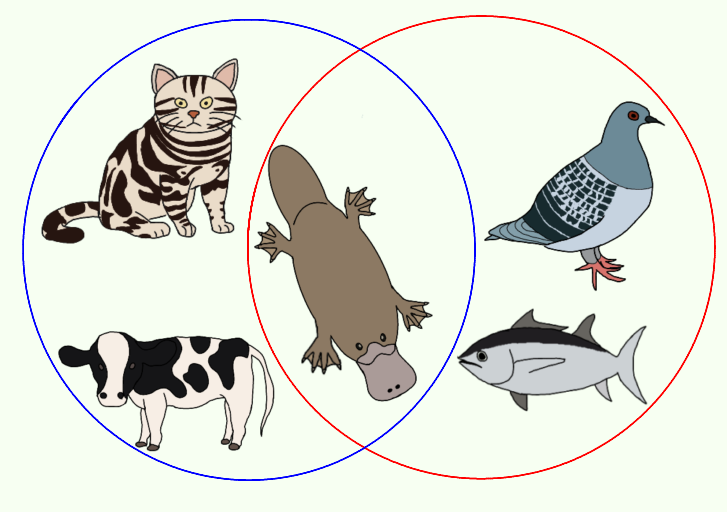
Hm, it might be easiest to understand if we think about the set of ‘mammals’ and the set of ‘egg-laying
animals.’
\[ \begin{align}
M &= \left\{ \text{platypus, cow, cat} \right\} \\\\
O &= \left\{ \text{platypus, tuna, pigeon} \right\} \\\\
M \cup O &= \left\{ \text{platypus, cow, cat, tuna, pigeon} \right\} \\\\
M \cap O &= \left\{ \text{platypus} \right\}
\end{align}\]
Kaya
That would mean the platypus is the only one that belongs to both ‘mammals’ and ‘egg-laying animals.’
The ideas of unions and intersections can also be applied to two or more sets.
So it is useful to consider the following.
\[ \text{Family of sets}\]
A family of sets refers to a collection of sets.
Let \( \Omega \) be a family of sets. The set of all elements that belong to at least one set in \(
\Omega \) is called the union of the family of sets \( \Omega \), and it is denoted by
\[ \bigcup_{X \in \Omega} X.\]
Similarly, the set of all elements that are common to all sets in \( \Omega \) is called the
intersection of the family of sets \( \Omega \), and it is denoted by
\[ \bigcap_{X \in \Omega} X.\]
\( \Omega \) is an uppercase Greek letter read as “omega.”
A “set of sets” means, for example, that if \( \Omega \) is the set of all types of playing cards, then
within it there are sets such as the set of hearts cards and the set of spades cards.
Kaya
Also, when we label sets with numbers, we use the following method.
Index set
\[ \text{Numbering of Sets}\]
A family of sets \( \{ X_i \}_{i \in I} \) is a collection of sets where each element \( i \) in the
index set \( I \) corresponds to one set \( X_i \).
The union of this family of sets is denoted by
\[ \bigcup_{i \in I} X_i,\]
and the intersection of this family is denoted by
\[ \bigcap_{i \in I} X_i.\]
When \( I \) is a finite set with \( n \) elements, denoted as \( 1, 2, \dots, n \), the family of sets
\( \{ X_i \}_{i \in I} \) can also be written as
\[ \{ X_i \}_{i=1, 2, \dots, n},\]
and the union is expressed as
\[ \bigcup_{i=1}^n X_i \quad \text{or} \quad X_1 \cup X_2 \cup \cdots \cup X_n,\]
and the intersection is written as
\[ \bigcap_{i=1}^n X_i \quad \text{or} \quad X_1 \cap X_2 \cap \cdots \cap X_n.\]
When \( I \) is the set of all positive integers, the union of the family of sets \( \{ X_i \}_{i \in I}
\) is written as
\[ \bigcup_{i=1}^{\infty} X_i,\]
and the intersection is written as
\[ \bigcap_{i=1}^{\infty} X_i.\]
Nayumi
There are quite a few different notations, aren’t there?
Kaya
There are, since different situations call for different ones. Next, let’s think about the difference
between sets.
Complement
\[ \text{Complement}\]
Let \( X \) and \( Y \) be two sets. The set of elements that are in \( Y \) but not in \( X \) is
denoted by \( Y - X \).
Specifically, when \( X \subset Y \), the set \( Y - X \) is called the complement of \( X \)
with respect to \( Y \).
When all the sets under consideration are subsets of a set \( U \), \( U \) is called the universal set. In this case, the set of elements that are not in a set \( X \) but are in the universal set \( U \) is simply called the complement of \( X \), and it is denoted by \[ U - X = X^c.\]
When all the sets under consideration are subsets of a set \( U \), \( U \) is called the universal set. In this case, the set of elements that are not in a set \( X \) but are in the universal set \( U \) is simply called the complement of \( X \), and it is denoted by \[ U - X = X^c.\]
For example, if we take the universal set \( U \) to be “all types of playing cards” and the set \( X \) to
be “hearts cards,” then the complement \( X^c \) is “all playing cards other than hearts.”
Kaya
Next, let’s take a look at De Morgan’s laws, which are laws concerning complements of sets.
\[ \text{De Morgan's Laws}\]
The following De Morgan's Laws hold for complements:
\[ \left( X \cup Y \right) ^c = X^c \cap Y^c \]
\[ \left( X \cap Y \right) ^c = X^c \cup Y^c \]
For the upper one, let the universal set be “all types of playing cards,” let \( X \) be “hearts cards,”
and let \( Y \) be “face cards.” Then it means that the cards other than “hearts cards or face cards” are
equal to the overlap of “cards other than hearts” and “cards other than face cards.”
For the lower one, conversely, the cards other than “hearts face cards” are equal to the union of “cards other than hearts” and “cards other than face cards.”
For the lower one, conversely, the cards other than “hearts face cards” are equal to the union of “cards other than hearts” and “cards other than face cards.”
Kaya
Next, let’s briefly touch on the power set.
Power set
\[ \text{Power set}\]
The set of all subsets of a given set is called the power set.
The power set of a set \( U \) is denoted by
\[ \mathcal{P}(U).\]
For example, if we let the set \( U \) be
\[ U = \left\{ 〇,\ ×\right\}\]
then the power set \( \mathcal P \rm ( \it U \rm ) \) is as follows.
\[ \mathcal P \rm ( \it U \rm ) = \left\{ \left\{ 〇,\ ×\right\} ,\ \left\{ 〇\right\}, \ \left\{
×\right\}, \varnothing \right\}\]
When the original set is finite, if the number of elements in the original set is \( x, \) then the number
of elements in its power set is \( 2^x \).
This is because, for each of the \( x \) elements, there are two possibilities: it is either included or not
included.
Kaya
Next, let’s define the Cartesian product, which pairs elements from two sets.
Cartesian product
\[ \text{Cartesian product} \]
Let \( I = \{ 1, 2, \dots, n \} \) be a finite set, and let \( \{ X_i \}_{i=1, 2, \dots, n} \) be a
family of sets indexed by \( I \).
Then, by selecting one element \( x_i \) from each \( X_i \), we can form an ordered tuple
\[ \left( x_1 , \ x_2 , \ \cdots , \ x_n \right). \]
The set of all such ordered tuples is called the Cartesian product of the family \( \{ X_i
\}_{i=1, 2, \dots, n} \) (or the Cartesian product of \( X_1, X_2, \dots, X_n \)). It is denoted by
\[ X_1 \times X_2 \times \cdots \times X_n \quad \text{or} \quad \prod_{i=1}^n X_i.\]
For an element \( z = (x_1, x_2, \dots, x_n) \) of the Cartesian product
\[ Z = X_1 \times X_2 \times \cdots \times X_n ,\]
each \( x_i \) is called the component or the \( i \)th component of \( z \).
Sometimes, the term coordinate is used instead of component.
As a concrete example, let
\[ X_1 = \left\{ \text{rice,} \ \text{bread} \right\} \]
\[ X_2 = \left\{ \text{fish,} \ \text{chicken} \right\}. \]
Then the elements of \( Z = X_1 \times X_2 \) are
\( \left( \text{rice,} \ \text{fish} \right)\),
\( \left( \text{rice,} \ \text{chicken} \right)\),
\( \left( \text{bread,} \ \text{fish} \right)\),
\( \left( \text{bread,} \ \text{chicken} \right)\),
for a total of four elements.
Kaya
Finally, let’s define the term that refers to the number of elements contained in a set.
Cardinality
\[ \text{Cardinality of a finite set}\]
For a finite set \( X \), the number of elements in \( X \) is called the cardinality of \( X
\), and it is denoted by
\[ |X|.\]
When \( X \) and \( Y \) are finite sets, the following holds regarding the cardinality:
\[ |X \cup Y| = |X| + |Y| - |X \cap Y |\]
Referring back to the example of mammals and egg-laying animals, the number of elements in the union \( |M
\cup O| \) is calculated as follows.
There are three mammals: platypus, cow, and cat.
There are three egg-laying animals: platypus, tuna, and pigeon.
Only the platypus belongs to both sets, so the number of common elements is 1. Therefore, \[ |M \cup O| = 3 + 3 - 1 = 5.\] Since the platypus is counted twice when simply adding 3 and 3, we subtract 1 to correct for the double counting.
There are three mammals: platypus, cow, and cat.
There are three egg-laying animals: platypus, tuna, and pigeon.
Only the platypus belongs to both sets, so the number of common elements is 1. Therefore, \[ |M \cup O| = 3 + 3 - 1 = 5.\] Since the platypus is counted twice when simply adding 3 and 3, we subtract 1 to correct for the double counting.
Nayumi
…I’ve followed along this far, but what do we actually use this for?
Kaya
Sets will appear in the discussion of “probability” that we’ll cover later, so I explained them in
advance.
Nayumi
I see. I’ll keep that in mind.
Reference:
[1] 松坂和夫, 現代数学序説 ──集合と代数, 筑摩書房, December 6, 2017
Previous
Ep. 13
Definite integral
Definite integral
Next
Ep. 15
Permutation/
Combination/
Binomial theorem
Permutation/
Combination/
Binomial theorem